

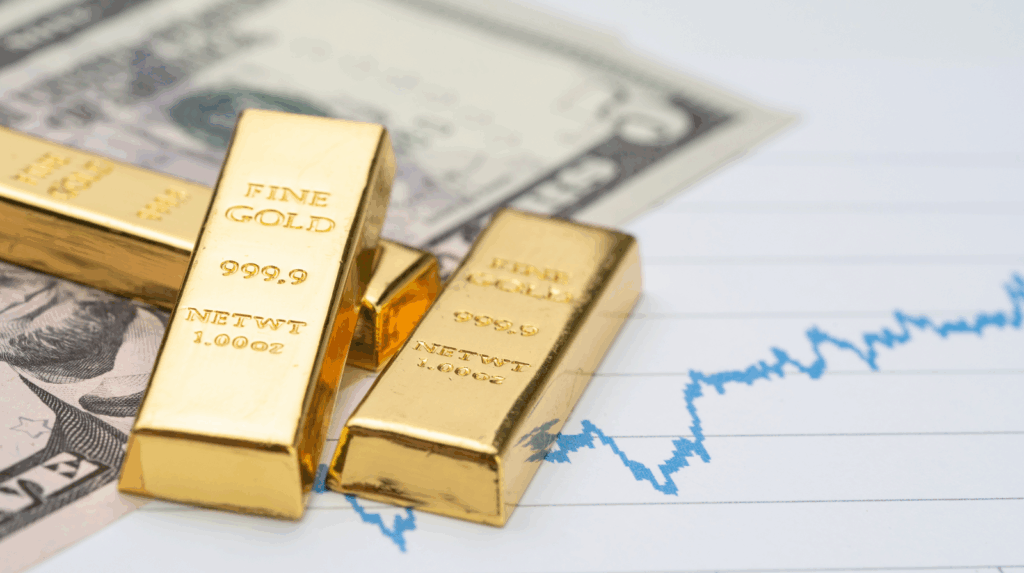

If you are living on a fixed income, you don’t need a Wall Street analyst to tell you that inflation is real. You see it every time you fill up your gas tank, pay your utility bill, or walk through the grocery checkout line. While your Social Security check might get a small Cost-of-Living Adjustment (COLA), those raises rarely keep pace with the actual cost of living in the “real world.”
Inflation is the “Invisible Thief” of retirement. It doesn’t take money out of your bank account; it simply makes the money that is already there worth less.
As your trusted advocate, we are here to show you how to fight back. In this guide, we will explore why physical gold has remained the world’s premier “Inflation Shield” for over 5,000 years, the math behind its purchasing power, and how a small allocation of gold can act as an insurance policy for your lifestyle.
Key Takeaways
- The Purchasing Power Gap: Since the 1970s, the U.S. Dollar has lost over 85% of its value, while gold has increased by over 5,000%.
- Hard Asset Security: Unlike paper money, gold cannot be printed by a central bank. Its scarcity is its strength.
- The Inverse Relationship: When the dollar weakens, gold prices traditionally rise, balancing out the loss in your “cash” bucket.
- The Strategy: Gold isn’t about “getting rich”; it is about staying at the same level of comfort regardless of the economy.
Protect your retirement savings from the “Invisible Thief.” Request your free kit today.
The Math of Erosion: Why Your Savings are Shrinking
To understand why gold is a “Shield,” you must first understand the “Sword” of inflation. Economists use the Consumer Price Index (CPI) to track prices, but for seniors, the reality is often harsher.
The “Coffee & Bread” Math: Imagine you retired in 2000 with $100,000 in a safe under your bed.
- In 2000, that $100,000 could buy a certain amount of goods and services.
- In 2026, due to an average inflation rate of roughly 3%, that same $100,000 only has the purchasing power of approximately **$44,000**.
The Formula for Purchasing Power Loss:
P =C(1 + r)^n
Where P is the future power, C is the initial cash, r is the inflation rate, and n is the number of years.
sageWISE Verdict: Keeping 100% of your retirement in cash or bonds is a high-risk gamble against time. You are essentially betting that the government can keep inflation lower than your interest rate—a bet that hasn’t paid off for most retirees in the last decade.
Why Gold is the "Ultimate Hedge"
Gold is often called a “Hedge” because it acts like a financial counterweight. When “Paper Assets” (like the dollar, stocks, or bonds) lose value due to inflation, currency devaluation, or market instability, “Hard Assets” (like physical gold and real estate) traditionally hold or increase their value. Unlike a digital entry in a bank’s ledger, gold has no “counterparty risk”—meaning its value doesn’t depend on a bank’s ability to stay solvent.
- Scarcity and Intrinsic Value: You cannot “print” more gold to solve a budget deficit. Every ounce of gold currently in existence must be mined, refined, and securely stored. This physical limit stands in direct contrast to “Fiat” currency (like the U.S. Dollar), which can be created in unlimited quantities by central banks. As the supply of dollars increases, the value of each individual dollar decreases; gold acts as a permanent anchor because its supply remains relatively constant.
- Global Liquidity & Borderless Value: Gold is the only currency that is recognized and accepted in every nation on Earth without the need for a central exchange. It is a universal “Store of Value” that functions outside the traditional banking system. If the U.S. banking system faces a “glitch” or a cyber-attack, your physical gold remains a liquid asset that can be converted to any currency at any time, providing a layer of security that digital-only assets cannot match.
- The Crisis Anchor (Safe Haven Status): During times of geopolitical tension, war, or domestic economic shifts, investors naturally “flee to safety.” This flight to quality drives the price of gold up exactly when traditional stock portfolios are suffering. This inverse relationship makes gold the “Safe Harbor” of the financial world, ensuring your portfolio has an anchor that prevents it from being swept away during economic storms.
The Sagewise Audit: Comparing 1971 to 2026
Let’s look at the most famous comparison in precious metals history: The “Ounce of Gold” test.
- In 1971: An ounce of gold cost $35. A nice suit for a gentleman also cost roughly $35.
- In 2026: An ounce of gold is worth over $2,500 (approx.). A high-quality, custom-tailored suit also costs roughly $2,500.
The Lesson: The gold didn’t actually “gain” value; it simply held its value. The dollar, however, failed the test completely. If you had saved $35 in a jar in 1971, you couldn’t even buy the socks for that suit today. If you had saved an ounce of gold, your lifestyle would remain exactly the same.
Interactive Tool: Gold IRA Inflation Shield Calculator
How much of your purchasing power could inflation eat over the next decade? Use our Gold IRA Inflation Shield Calculator to see how a diversified portion of physical gold could protect your nest egg.
Strategic Move: The 10% Diversification Rule
We are not suggesting you sell your home and buy a gold bar. As your financial advocate, we recommend a Defensive Diversification strategy that prioritizes the stability of your total wealth.
Most senior-focused financial planners suggest a 5% to 10% allocation to physical gold within a Self-Directed IRA. This specific range is often called the “Golden Insurance Policy” for your portfolio.
- The Goal (Portfolio Rebalancing): This allocation isn’t meant to be your primary “growth engine.” Instead, it is designed to offset “Drawdown Risk.” If the stock market drops 20% due to a sudden crash, or if the U.S. Dollar loses 5% of its purchasing power in a year of high inflation, the gains in your 10% gold bucket act as a financial cushion. This “hedging effect” helps keep your total portfolio value from dipping too deeply into the red.
- The Result (Defeating “Portfolio Vertigo”): When you are 100% in stocks and bonds, market volatility causes “Portfolio Vertigo”—that feeling of panic when you see your life savings fluctuate wildly on the news. By adding a hard asset like gold, your “Total Portfolio Value” remains significantly more stable. You aren’t just buying gold; you are buying the ability to sleep through market cycles, knowing your essential savings are shielded from the extremes of Wall Street.
Frequently Asked Questions (FAQ)
No. Gold is a “Store of Value,” not a business. It doesn’t produce products or pay dividends. You own it for the insurance it provides against the failure of other assets, not for quarterly checks.
In the short term, yes, gold prices can be volatile. But for a senior with a 20-year retirement horizon, gold has historically been much less risky than cash because it cannot be inflated to zero
A Gold IRA allows you to buy gold using pre-tax dollars. If you buy gold with cash from your checking account, you’ve already paid taxes on that money. An IRA gives you the maximum “Inflation Shield” by letting you invest the full amount of your retirement savings.
While anything is possible, modern experts believe this is highly unlikely. In 1933, the U.S. was on the “Gold Standard,” and the government needed the metal to control the currency. Today, our currency is “Fiat” (unbacked), and gold is treated as a private investment asset, similar to real estate.
Most retirees use gold as a “Legacy Asset.” They hold it throughout retirement to ensure their purchasing power stays intact, and then pass the physical metal to their heirs. If you need cash, a reputable Gold IRA company will offer a Buyback Guarantee to liquidate your metals quickly.
Request Your Free Gold IRA Kit (Secure your retirement with the historical stability of physical gold today.)